Should scientists be activists?
“I am concerned by climate scientists becoming climate activists, because scholars should not have a priori interests in the outcome of their studies.” That’s what Ulf Büntgen (University of Cambridge) wrote in a comment piece for npj Climate Action.
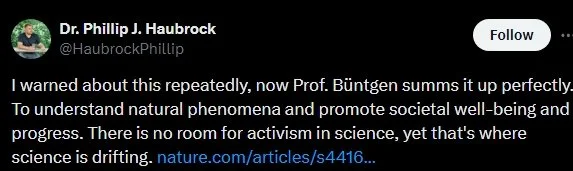
Some scientists agree:
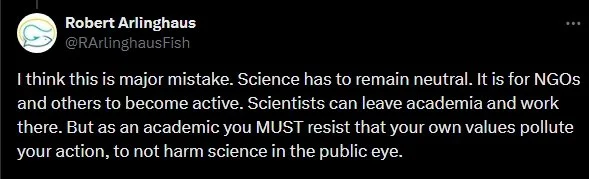
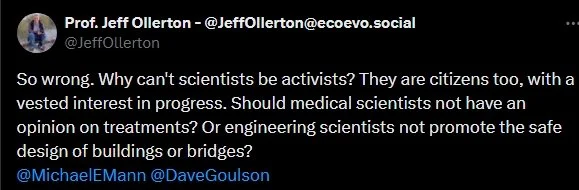
While others find the idea that climate scientists cannot be activists ridiculous.
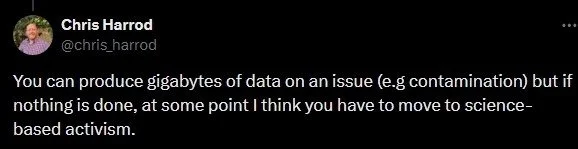
It’s an old debate and one that isn’t likely to be settled anytime soon. It’s not uncommon to find people pursuing science because they are concerned about the state of a particular species/the environment/climate/health, etc. For these people, science isn’t just about the pursuit of knowledge but creating knowledge and getting it out there so we can take action to improve things.
For some, that means taking on a more activist role to communicate their work.
Ulf implies that scientists are unable to separate themselves from their personal feelings and their science, whereas actually, it’s the very thing scientists are taught to do. Scientists may be motivated to enter a field or study a particular area because they are concerned, but that doesn’t mean that they deliberately bias their data or methodology to produce evidence. It doesn’t mean they lie or skew their results.
What it might mean is that they are keen to get their work out into the hands of those who can use it to make decisions to address the problems we’re facing, like climate change.
Few people argue that climate scientists shouldn’t be actively communicating their science. The question is, is activism a mode of communication too far?