What marine topics do the European media talk about?
Love it or loathe it, the "media" are crucial for getting information out into the world. So, what marine "topics" are journalists in Europe covering?
Researchers Bruno Pinto (Universidade de Lisboa) and Ana Matias (Universidade do Algarve) surveyed 26 journalists across Europe to find out.
This graph summarises what they found.
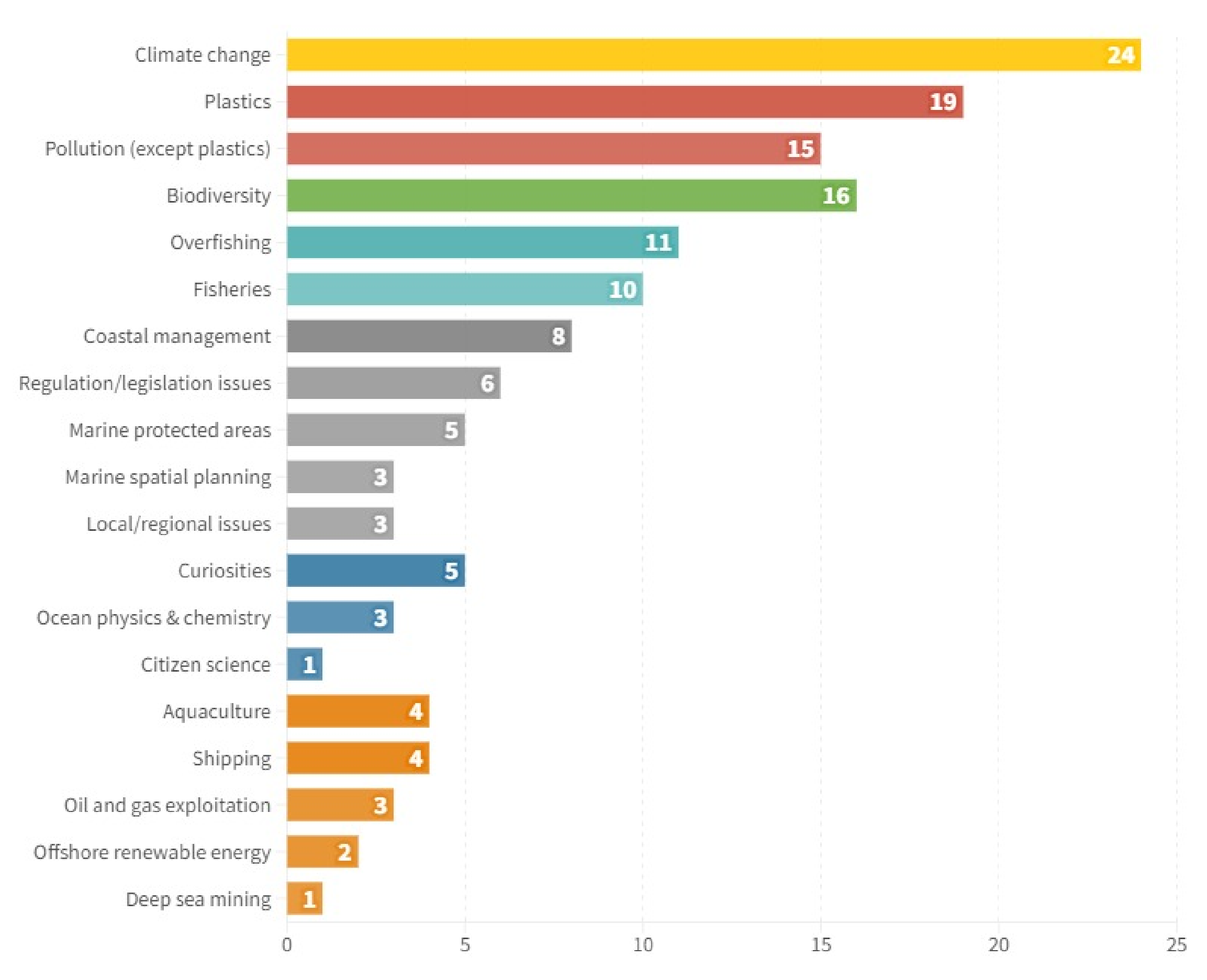
The frequency of topics mentioned by interviewees; climate change (colour yellow); pollution (colour red); biodiversity (colour green); fisheries (colour light blue); marine management (colour grey); ocean properties (colour dark blue), and economic activities (except fisheries; colour orange). Taken from the paper.
In brief, the top three most covered topics were
Climate change
Plastics
Biodiversity (plants and animals)
The least covered topics? Those were
Deep-sea mining
Citizen science initiatives
Offshore renewables
So, how do they pick what to cover and what not to? There are lots of different pieces to this puzzle - what else is going on in the world, national or local interest in a particular topic, who they write for and what sorts of things that publication covers, for example.
One piece that may be surprising is the role of sources. We're not just talking press releases here, but also relationships between the journalists and scientists, NGOs, and other groups that may be operating in the ocean space.
In fact, the journalists rated relationships, particularly with scientists, as vital.
So, what does that mean for scientists? In a nutshell, make friends with journalists!
What have you got to lose?
Read the (open access) paper
Pinto, B. and Matias, A. (2023). How European journalists cover marine issues JCOM 22(05), N02. https://doi.org/10.22323/2.22050802.